Contact Dynamics: LCP
In the previous blog post, we started from the Signorini condition and the maximum dissipation principle and obtained the nonlinear cone complementarity formulation
\[K_\mu \ni \lambda \perp \begin{bmatrix} c_T \\ \dfrac{1}{\Delta t}\phi(q_t)+c_N+\mu\Vert c_T\Vert_2 \end{bmatrix} \in K_\mu^*.\]In this post, we take a different route: we approximate the circular friction cone by a polyhedral cone and retain the multiplier associated with the friction bound as an explicit variable. The resulting optimality conditions are affine in the unknowns and can therefore be written as a Linear Complementarity Problem (LCP).
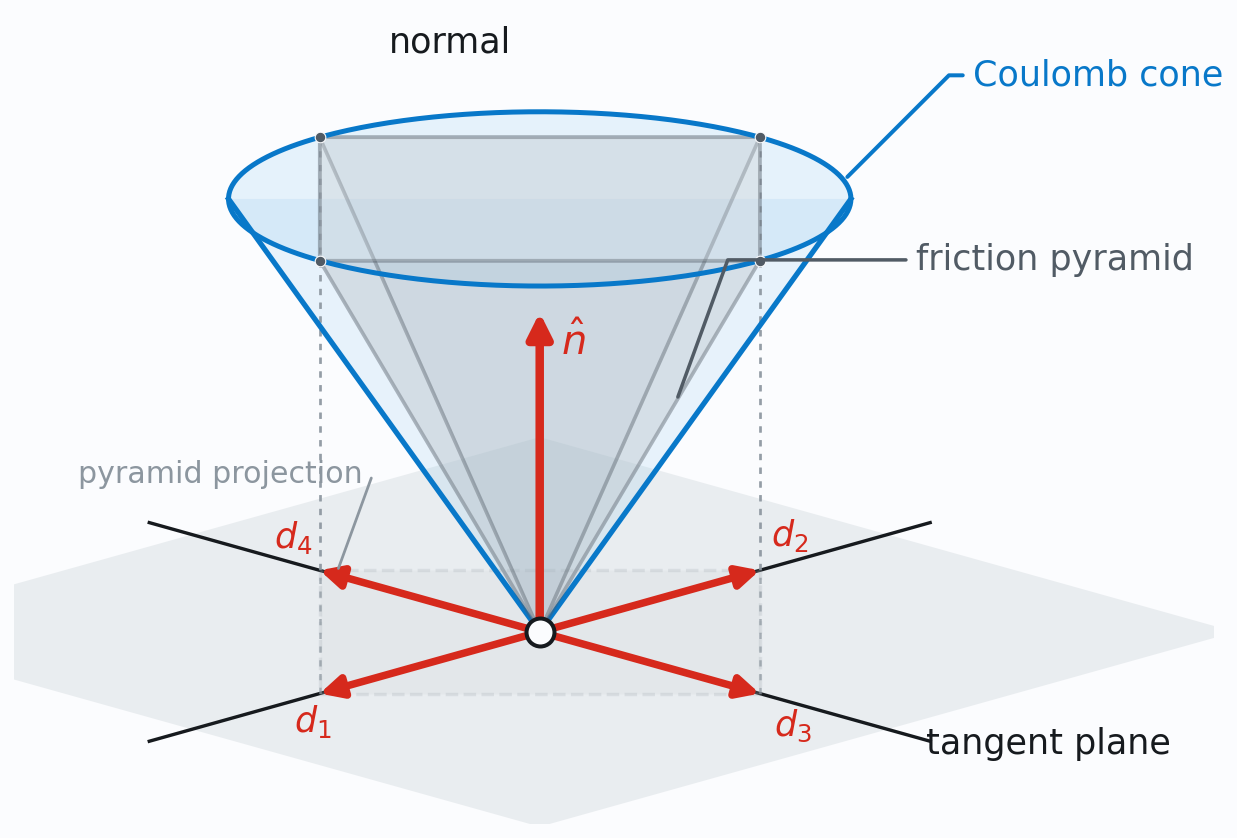
The construction follows the velocity-impulse time-stepping formulation used by Anitescu and Hart [1]. We first derive the contact conditions for one contact and then assemble the full LCP.
Recap: Signorini and Maximum Dissipation
To simplify the notation, we write $v:=v_{t+1}$ and define the discrete normal gap velocity
\[g_N := \frac{1}{\Delta t}\phi(q_t)+c_N.\]The discretized Signorini condition is
\[\begin{equation} \label{eq:lcp_signorini} 0\leq\lambda_N\perp g_N\geq0. \end{equation}\]Given a normal impulse $\lambda_N$, the maximum dissipation principle selects the tangential impulse from the Coulomb disk:
\[\begin{aligned} \underset{\gamma_T\in\mathbb{R}^2}{\operatorname{minimize}}\quad & \gamma_T^\top c_T \\ \operatorname{subject\ to}\quad & \Vert\gamma_T\Vert_2\leq\mu\lambda_N. \end{aligned}\]Polyhedral Approximation of the Friction Cone
Choose $m$ unit vectors in the tangent plane and collect them as
\[D := \begin{bmatrix} d_1 & d_2 & \cdots & d_m \end{bmatrix} \in\mathbb{R}^{2\times m}.\]We assume that the directions are balanced: for every $d_k$, the opposite direction $-d_k$ is also included. The circular cross-section of the friction cone is then approximated by the convex hull of these directions. We represent the tangential impulse as
\[\begin{equation} \label{eq:tangential_decomposition} \lambda_T=D\alpha, \qquad \alpha\geq0, \end{equation}\]where $\alpha\in\mathbb{R}^{m}$ contains the nonnegative impulse magnitudes along the selected directions. Let
\[e:=\mathbf{1}_{m} = \begin{bmatrix} 1 & \cdots & 1 \end{bmatrix}^{\top} \in\mathbb{R}^{m}.\]That is, $e$ is the $m$-dimensional column vector whose entries are all one. Consequently, $e^\top\alpha=\sum_{k=1}^m\alpha_k$ is the sum of all impulse coefficients.
For a fixed normal impulse $\lambda_N$, the polygonal cross-section is
\[\mu\lambda_N\operatorname{conv}\{d_1,\dots,d_m\}.\]Because the directions are balanced, the origin lies in this polygon. Hence, any admissible tangential impulse can be written as
\[\lambda_T =r\sum_{k=1}^m\theta_kd_k, \qquad 0\leq r\leq\mu\lambda_N, \qquad \theta_k\geq0, \qquad \sum_{k=1}^m\theta_k=1.\]Define $\alpha_k:=r\theta_k$. Then
\[\lambda_T=D\alpha, \qquad e^\top\alpha =\sum_{k=1}^m\alpha_k =r \leq\mu\lambda_N.\]Consequently, the exact Coulomb cone is approximated by
\[K_{\mu}^{\mathrm{poly}} := \left\{ (D\alpha,\lambda_N) \;\middle|\; \alpha\geq0,\; e^\top\alpha\leq\mu\lambda_N \right\}.\]Maximum Dissipation as a Linear Program
After the polyhedral approximation, the maximum dissipation problem becomes
\[\begin{aligned} \underset{\gamma\in\mathbb{R}^{m}}{\operatorname{minimize}}\quad & \gamma^\top D^\top c_T \\ \operatorname{subject\ to}\quad & \gamma\geq0, \\ & e^\top\gamma\leq\mu\lambda_N. \end{aligned}\]This is a linear program. Let $\beta\geq0$ be the scalar multiplier associated with the friction bound, and let $\rho\in\mathbb{R}^m_{\geq0}$ be the vector multiplier associated with $\gamma\geq0$. Its Lagrangian is
\[\mathcal{L}(\gamma,\beta,\rho) =\gamma^\top D^\top c_T +\beta\left(e^\top\gamma-\mu\lambda_N\right) -\rho^\top\gamma.\]At the optimum $\gamma=\alpha$, the KKT conditions are
\[\begin{aligned} \alpha\geq0,\quad e^\top\alpha\leq\mu\lambda_N &\qquad\text{(primal feasibility)}\\ \rho\geq0,\quad\beta\geq0 &\qquad\text{(dual feasibility)}\\ D^\top c_T+e\beta-\rho=0 &\qquad\text{(stationarity)}\\ \alpha^\top\rho=0,\quad \beta\left(\mu\lambda_N-e^\top\alpha\right)=0 &\qquad\text{(complementary slackness)}. \end{aligned}\]Stationarity gives $\rho=D^\top c_T+e\beta$. Substituting this expression into $\alpha\geq0$, $\rho\geq0$, and $\alpha^\top\rho=0$ eliminates $\rho$ and gives the first complementarity pair:
\[\begin{equation} \label{eq:direction_complementarity} 0\leq\alpha \perp D^\top c_T+e\beta \geq0. \end{equation}\]Primal feasibility, dual feasibility, and complementary slackness for the friction bound give the second pair:
\[\begin{equation} \label{eq:friction_bound_complementarity} 0\leq\beta \perp \mu\lambda_N-e^\top\alpha \geq0. \end{equation}\]Equations $\eqref{eq:direction_complementarity}$ and $\eqref{eq:friction_bound_complementarity}$ are the polyhedral version of maximum dissipation.
Combining Signorini with the KKT conditions of maximum dissipation gives
\[\begin{equation} \label{eq:single_contact_complementarity} \begin{aligned} 0\leq\lambda_N &\perp \frac{1}{\Delta t}\phi(q_t)+c_N \geq0, \\ 0\leq\alpha &\perp D^\top c_T+e\beta \geq0, \\ 0\leq\beta &\perp \mu\lambda_N-e^\top\alpha \geq0, \\ \lambda_T&=D\alpha. \end{aligned} \end{equation}\]At this point the contact conditions are componentwise complementarity conditions, but they are not yet a closed LCP: the contact velocities $c_N$ and $c_T$ still depend on the unknown generalized velocity. We next use the discrete equations of motion to express those velocities in terms of the contact variables.
Coupling the Contacts to Multibody Dynamics
We now restore the contact index $i$. Let $N_c$ be the number of candidate contacts and let
\[m:=\sum_{i=1}^{N_c}m_i.\]Let $v$ denote the generalized velocity of the multibody system. Multiplying it by the contact Jacobians gives the relative contact velocities, so we stack the normal and tangential components as
\[\boldsymbol{c}_N=J_Nv, \quad \boldsymbol{c}_T=J_Tv,\]where
\[J_N\in\mathbb{R}^{N_c\times n_v}, \quad J_T\in\mathbb{R}^{2N_c\times n_v}.\]We define the block matrices as follows:
\[\begin{aligned} D&:=\operatorname{blkdiag}(D_1,\dots,D_{N_c}) \in\mathbb{R}^{2N_c\times m},\\ E&:=\operatorname{blkdiag}(e_1,\dots,e_{N_c}) \in\mathbb{R}^{m\times N_c},\\ \mathrm{M}_{\mu}&:=\operatorname{diag}(\mu_1,\dots,\mu_{N_c}). \end{aligned}\]Here each column of $E$ contains the vector of ones associated with one contact. With
\[\boldsymbol{\lambda}_N = \begin{bmatrix} \lambda_{N,1}&\cdots&\lambda_{N,N_c} \end{bmatrix}^\top,\]and the stacked vector $\boldsymbol{\alpha}$, the generalized contact impulse is
\[J_N^\top\boldsymbol{\lambda}_N +J_T^\top D\boldsymbol{\alpha}.\]Recall the discrete equation of motion
\[M(v_{t+1}-v_t) =\Delta t\left(\tau_t-h(q_t,v_t)\right) +J_N^\top\boldsymbol{\lambda}_N +J_T^\top D\boldsymbol{\alpha}.\]Collecting the terms that do not involve contact defines the free-motion velocity
\[v^f := v_t+M^{-1}\Delta t\left(\tau_t-h(q_t,v_t)\right).\]Thus, the discrete dynamics can be written as
\[\begin{equation} \label{eq:lcp_dynamics} M(v_{t+1}-v^f) =J_N^\top\boldsymbol{\lambda}_N +J_T^\top D\boldsymbol{\alpha}. \end{equation}\]Define the complementarity residuals
\[\begin{aligned} \boldsymbol{w}_N &:=J_Nv_{t+1}+\frac{\boldsymbol{\phi}(q_t)}{\Delta t},\\ \boldsymbol{w}_{\alpha} &:=D^\top J_Tv_{t+1}+E\boldsymbol{\beta},\\ \boldsymbol{w}_{\beta} &:=\mathrm{M}_{\mu}\boldsymbol{\lambda}_N-E^\top\boldsymbol{\alpha}. \end{aligned}\]The dynamics and contact conditions are therefore
\[\begin{equation} \label{eq:mixed_lcp} \begin{bmatrix} M & -J_N^\top & -J_T^\top D & 0\\ J_N & 0 & 0 & 0\\ D^\top J_T & 0 & 0 & E\\ 0 & \mathrm{M}_{\mu} & -E^\top & 0 \end{bmatrix} \begin{bmatrix} v_{t+1}\\ \boldsymbol{\lambda}_N\\ \boldsymbol{\alpha}\\ \boldsymbol{\beta} \end{bmatrix} + \begin{bmatrix} -Mv^f\\ \boldsymbol{\phi}(q_t)/\Delta t\\ 0\\ 0 \end{bmatrix} = \begin{bmatrix} 0\\ \boldsymbol{w}_N\\ \boldsymbol{w}_{\alpha}\\ \boldsymbol{w}_{\beta} \end{bmatrix}. \end{equation}\]The first block row is an equality. The remaining rows are the multi-contact version of the conditions in $\eqref{eq:single_contact_complementarity}$, and the remaining variables and residuals satisfy
\[\begin{bmatrix} \boldsymbol{\lambda}_N\\ \boldsymbol{\alpha}\\ \boldsymbol{\beta} \end{bmatrix} \geq0, \qquad \begin{bmatrix} \boldsymbol{w}_N\\ \boldsymbol{w}_{\alpha}\\ \boldsymbol{w}_{\beta} \end{bmatrix} \geq0,\]and
\[\boldsymbol{\lambda}_N^\top\boldsymbol{w}_N +\boldsymbol{\alpha}^\top\boldsymbol{w}_{\alpha} +\boldsymbol{\beta}^\top\boldsymbol{w}_{\beta} =0.\]For a standard LCP, all unknowns must be nonnegative complementarity variables. Since $M$ is positive definite, we can eliminate $v$ from $\eqref{eq:lcp_dynamics}$:
\[v_{t+1} =v^f+M^{-1} \left( J_N^\top\boldsymbol{\lambda}_N +J_T^\top D\boldsymbol{\alpha} \right).\]Substituting this expression into the contact residuals gives
\[\begin{aligned} \boldsymbol{w}_N ={}&J_NM^{-1}J_N^\top\boldsymbol{\lambda}_N +J_NM^{-1}J_T^\top D\boldsymbol{\alpha} +J_Nv^f +\frac{\boldsymbol{\phi}(q_t)}{\Delta t},\\ \boldsymbol{w}_{\alpha} ={}&D^\top J_TM^{-1}J_N^\top\boldsymbol{\lambda}_N +D^\top J_TM^{-1}J_T^\top D\boldsymbol{\alpha} +E\boldsymbol{\beta} +D^\top J_Tv^f,\\ \boldsymbol{w}_{\beta} ={}&\mathrm{M}_{\mu}\boldsymbol{\lambda}_N -E^\top\boldsymbol{\alpha}. \end{aligned}\]Define
\[\boldsymbol{z}:= \begin{bmatrix} \boldsymbol{\lambda}_N\\ \boldsymbol{\alpha}\\ \boldsymbol{\beta} \end{bmatrix}.\]The standard LCP is
\[\begin{equation} \label{eq:standard_lcp} 0\leq \boldsymbol{z} \perp A \boldsymbol{z} + b\geq0, \end{equation}\]with
\[\begin{equation} \label{eq:lcp_matrix} A= \begin{bmatrix} J_NM^{-1}J_N^\top & J_NM^{-1}J_T^\top D & 0\\ D^\top J_TM^{-1}J_N^\top & D^\top J_TM^{-1}J_T^\top D & E\\ \mathrm{M}_{\mu} & -E^\top & 0 \end{bmatrix}, \qquad b= \begin{bmatrix} J_Nv^f+\boldsymbol{\phi}(q_t)/\Delta t\\ D^\top J_Tv^f\\ 0 \end{bmatrix}. \end{equation}\]This is now in the form expected by a standard LCP solver: find $\boldsymbol{z}\geq0$ such that $A\boldsymbol{z}+b\geq0$ and $\boldsymbol{z}^\top \left( A\boldsymbol{z}+b \right) =0$.
References
- A Constraint-Stabilized Time-Stepping Approach for Rigid Multibody Dynamics with Joints, Contact and FrictionInternational Journal for Numerical Methods in Engineering, 2004